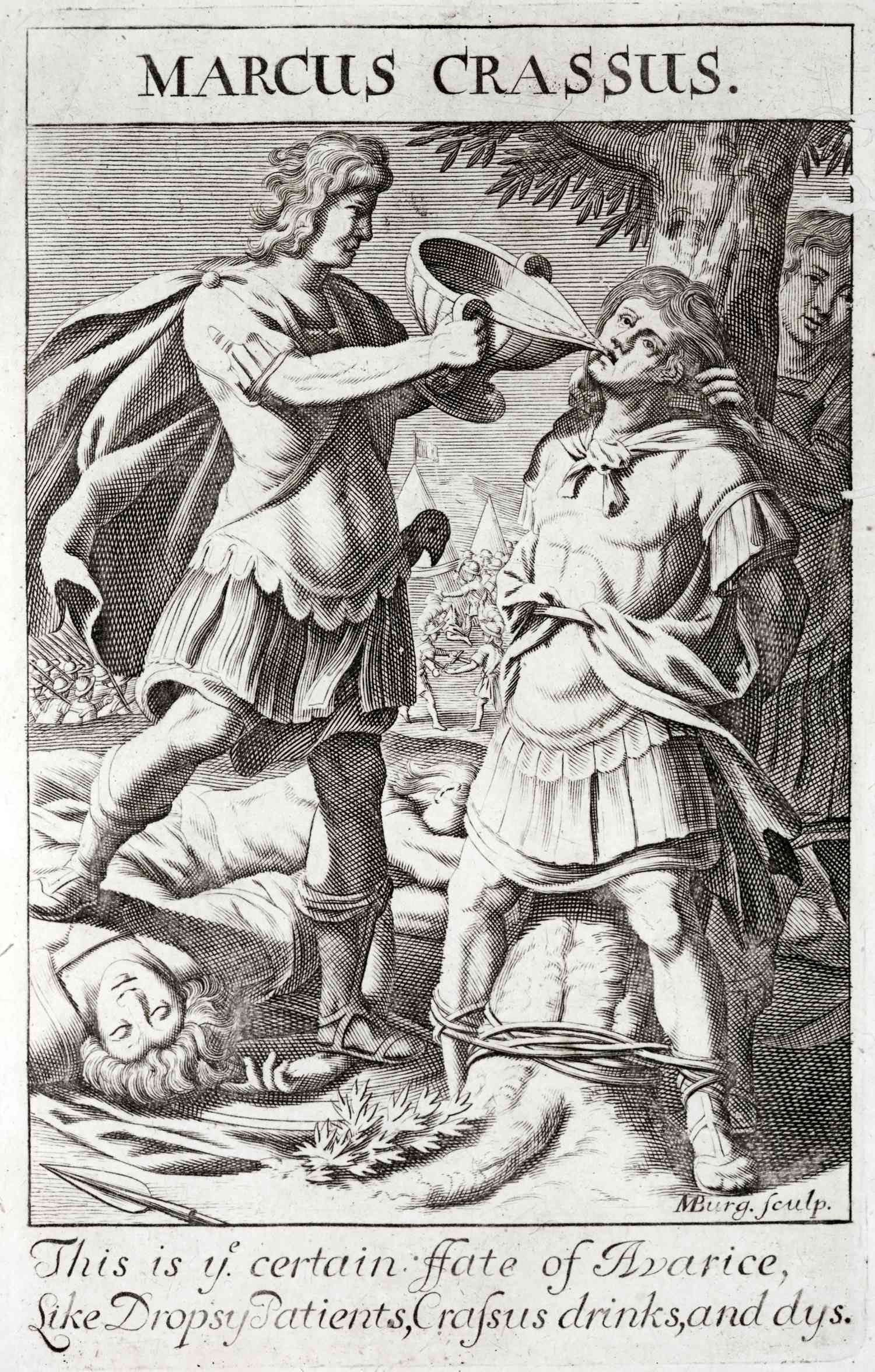
When we think of extreme wealth, we usually picture modern billionaires. But long before stock markets, venture capital, or tech empires, one Roman amassed a fortune so large that it equaled a substantial share of the Roman Republic’s annual finances.
His name was Marcus Licinius Crassus, and here is how he built his fortune.
Buying the Dip
Unsurprisingly, his fortune has a controversial entry point. For Crassus, it was the civil wars happening between Sulla and the Marian Faction in 82 BCE.
When Sulla took power as dictator, he created the proscriptions, a list of political enemies whose estates were confiscated by the state and auctioned off at rock-bottom prices. Most Romans hesitated out of fear or morals, but Crassus saw this as a giant opportunity.
He used his initial capital to bid for vast amounts of land, villas and agricultural estates across Italy. By buying when blood was quite literally in the streets, Crassus established a massive base of productive real estate and agricultural land. This was opportunistic distressed buying. He knew that market sentiment drops fastest during political instability, and that assets like land will retain their value after instability subsides.
The Private Fire Brigade
Crassus’s most famous, and predatory, business was his Rome-wide firefighting force. Ancient Rome was plagued by constant fires due to wooden architecture and tight alleys, and open flames that were used for heating and cooking.
Seeing this, Crassus formed a private brigade of over 500 slaves who were trained as architects, engineers, and builders. When real estate caught fire, Crassus’s team would quickly get to the scene, but they wouldn’t extinguish the fire. They would start negotiating.
They would approach the property owner and offer to buy the burning building, along with any neighbouring properties that were on fire or threatened by the fire, right on the spot for a fraction of its real value. If the owner agreed under the immense pressure, they would buy the land, extinguish the fire, and his builders would start renovating the property. If the owner refused to sell it, they would let the property burn, and sometimes offer to buy it after it had burned down for even less. Through this cycle, Crassus was able to own a massive portion of rental housing in Rome, generating a lot of cash flow through rents collected as the city expanded in population
Vertically Integrated Labour and Silver Mines
Real estate wasn’t Crassus’s only asset. He was great at vertical integration across multiple sectors. He owned silver mines in Spain, providing a direct supply of metals that were minted into coins or used as collateral. He also “invested” in human capital by purchasing enslaved workers and training them to do whatever labour he needed done. He would then lease out his workforce to other Roman elites or use them to manage his own enterprise.
Crassus also lent out money, for financial gain and also political gain. He would lend money interest-free to up and coming politcians. He actually lent money to a young, deeply in debt Julius Caesar. Doing this, he gained political protection, influence in politics and access to any potential future state contracts.
His Fatal Expansion
Despite controlling Rome’s economy, Crassus lacked the military strength and knowledge of his Triumvirate partners, Pompey and Caesar. In 53 BCE, desperate for some military clout, he funded and led an invasion of the Parthian Empire.
This was probably one of the worst misallocations of capital in military history. At the Battle of Carrhae, a city in Mesopotamia, the heavily armoured Roman legions were completely outmaneuvered by Parthian horse archers. Crassus was killed and according to a legend, the Parthians poured molten gold down his throat to mock his greed for wealth.
His downfall teaches a lesson: skills in one area don’t translate seamlessly to another area, and investing in something without properly understanding it can wipe out a lifetime of gains.