
Being extraordinarily smart does not make you immune to terrible financial decisions. Sir Isaac Newton proved this.
By 1720, Newton was not only the person who discovered gravity and co-invented calculus; he was also working as the Master of the Royal Mint and spent his days chasing counterfeiters, setting standards for national currencies and balancing huge balance sheets. He knew more about mathematics, economics and risks than almost anyone else at that time.
But when the speculative bubble hit London, all his wisdom and experience became irrelevant.
The bubble was all about the South Sea Company, a company which made an enormous bargain with the British government and took national debts on itself and got exclusive trading rights in Spanish America in return. While the actual earnings from the trade were negligible, the publicity surrounding the deal was immense. Seeing this, Newton invested in the company early on.
At first, he handled the position like a textbook disciplined investor. As the stock steadily climbed through the spring of 1720, he decided not to push his luck. By April, he sold all his shares for around £7000. He had invested £3500, so he doubled his money and walked away. It was right around this time that he famously realized he could “calculate the motions of heavenly bodies, but not the madness of people.”
Now the FOMO kicked in. It’s something that every investor faces when he sees the market going higher after getting out of it.
Contrary to what he expected, South Sea stock skyrocketed from April to July. Having already sold his shares for a 100% profit, Newton sat back and watched as London society, politicians, and close friends turned modest sums into vast fortunes on paper. What should have felt like a massive win suddenly felt like a terrible mistake.
His FOMO became too much to bear, and he let go of his discipline by pouring virtually all his net worth back into the stock.
The timing could not have been worse. The mania ran out of buyers, insiders and investors cashed out, and the bubble popped. The stock went into a freefall, crashing back under £200 by the end of 1720.
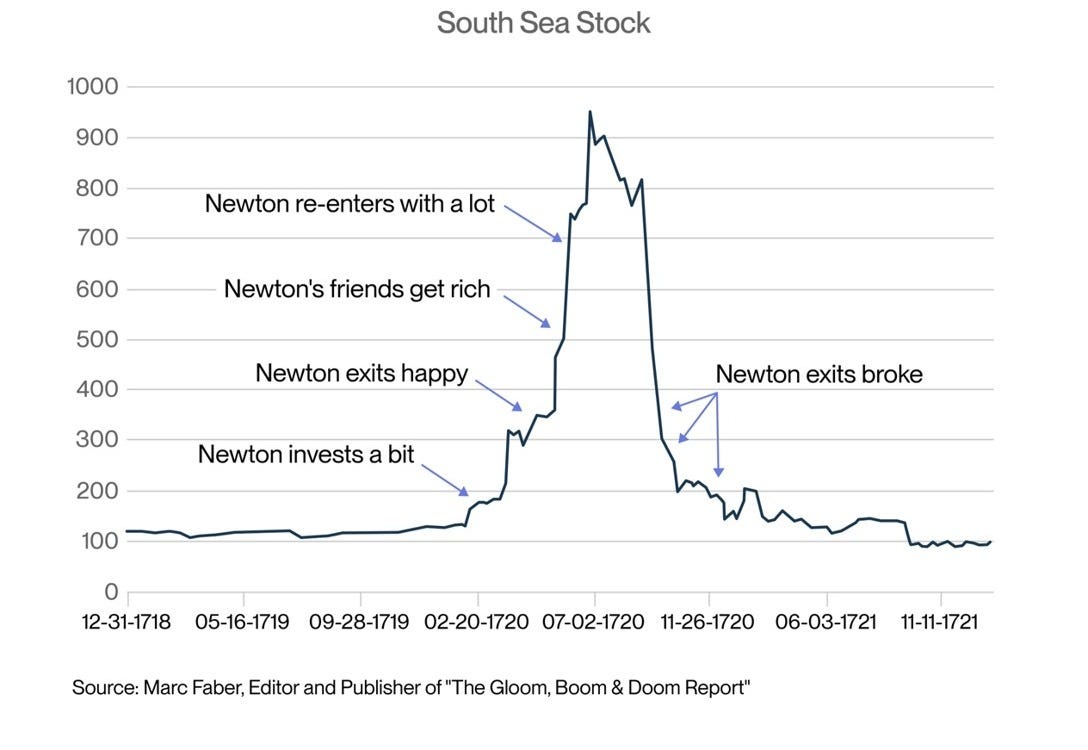
Newton lost around £20,000, the equivalent of roughly $4.5 million today. The crash wiped out his earlier profits and also wiped out a huge portion of his life savings. He took the loss so hard that he didn’t let anyone say the words “South Sea” anywhere near him. 1
This is probably one of the most interesting examples in history to show that investments are not an intelligence test. No matter how intelligent you are, there will be no escape from the laws of psychology, especially when emotions like regret and FOMO come into play.
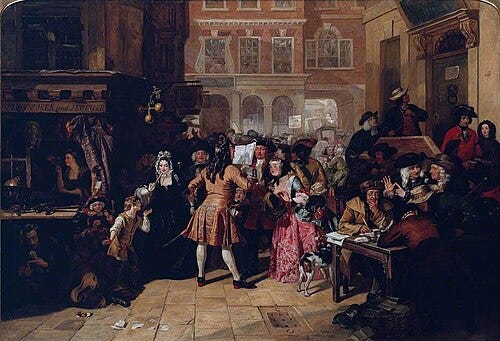
https://openculture.com/2018/01/how-isaac-newton-lost-3-million-dollars-in-the-south-sea-bubble-of-1720-even-geniuses-cant-prevail-against-the-machinations-of-the-markets.html
Painting: https://en.wikipedia.org/wiki/The_South_Sea_Bubble